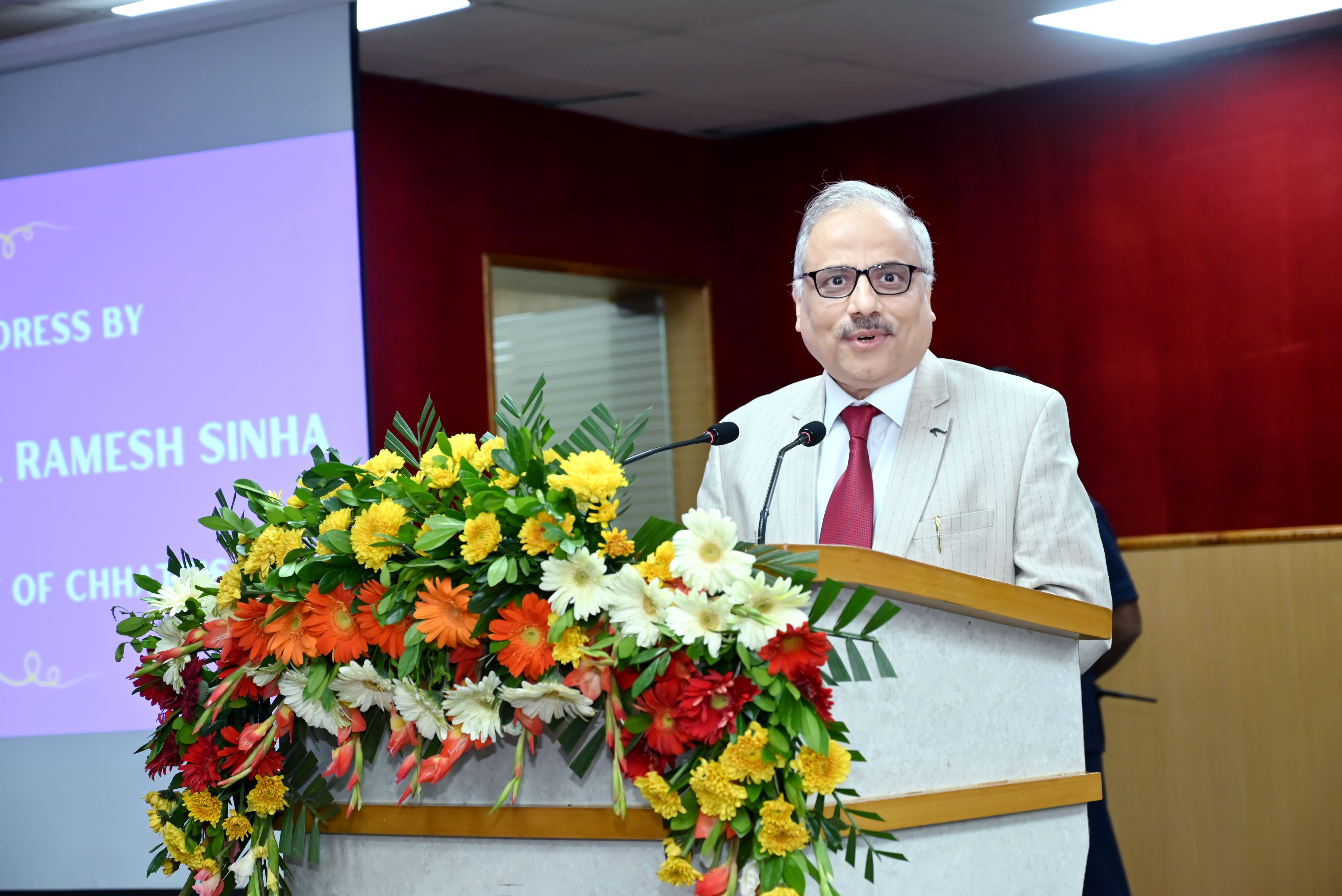
Hon'ble The Chief Justice

(Hon'ble The Chief Justice)
1. Sale Notice No. 8077 Tender/Pro/2026 Dated 28/04/2026.
2. Order No. 12/HCLSC/2026 Dated 28/04/2026
3. Notification No. 11/HCLSC/2026 Dated 28/04/2026
4. Notice for Recruitment to the Post of Junior Judicial Assistant (Computer)
5. Sale Notice No. 8076 Tender/Pro/2026 Dated 28/04/2026
6. Notification No. 7990 /R.(J.)/2026 Bilaspur, Dated 27/04/2026
7. Notice for Recruitment to the Post of Translator.
8. Notice for the Recruitment to the post of Junior Judicial Assistant (Computer)
9. Notification No. 103(Mis.) Bilaspur Dated 25/04/2026
10. Notification No. 307/Confdl./2026 Bilaspur dated 22/04/2026
1. Non-compliance with Sections 42, 50 and 52-A of the Narcotic Drugs and Psychotropic Substances Act, 1985, by itself does not vitiate the prosecution case unless prejudice is shown or the recovery itself becomes doubtful. Procedural safeguards cannot override substantive proof, and where recovery, possession and chain of custody stand duly established through cogent evidence, conviction can be sustained not with standing such lapses.
2. A "related" witness, who is also an injured witness, who may be naturally present at the scene of the crime, his testimony should not be dismissed simply because of his relationship to the victim and the Court must assess the reliability, consistency, and coherence of his statement rather than labeling him as untrustworthy.
3. Where a DNA test has been conducted following due procedure, with proper sampling and preservation, and there is no material to suggest tempering, contamination, or procedural irregularities, the result thereof carry significant evidentiary value and ought to be accepted. Mere conjectures or unfounded doubts are insufficient to discard DNA test findings. Court must accord due primacy to reliable scientific evidence unless its credibility is substantially dented.
4. Where the prosecution fails to conclusively establish the minority of the victim, the provisions of the POCSO Act may not be attracted. However, if the evidence on record, particularly the consistent and trustworthy testimony of the victim, duly corroborated by medical evidence (MLC) and forensic science laboratory (FSL) report indicating presence of seminal stains and human sperm on the victim’s body and clothing, establishes that she was abducted and subjected to sexual assault by multiple accused acting in furtherance of a common intention, conviction under Sections 366 and 376D IPC is fully sustainable. Absence of injuries or a conclusive medical opinion does not negate the offence, and each accused, being part of the group, is constructively liable for the act of gang rape irrespective of individual role.
5. Properties acquired prior to the alleged offence are not automatically immune from attachment under the PMLA. The definition of “proceeds of crime” under Section 2(1)(u) includes not only tainted property but also its equivalent value, reflecting a broad legislative intent. Where the actual proceeds are unavailable or untraceable, authorities may attach other properties of equivalent value, even if lawfully acquired or purchased earlier. Such attachment aims to prevent offenders from retaining the economic benefits of crime.
6. Testimony of the victim is vital, and unless compelling reasons exist necessitating corroboration, the Court may safely act upon the testimony of the victim of sexual assault alone to convict an accused where it inspires confidence and is found to be reliable, particularly when it is duly strengthened by corroborative medical evidence indicating pregnancy during the relevant period and further supported by DNA analysis of the child, lending scientific assurance to the prosecution version.
7. Repeated or indirect attempts to reopen concluded issues through collateral proceedings are impermissible and barred by the principles of res judicata and finality.
8. Frivolous and motivated petitions filed under the guise of public interest, liable to be discouraged by imposition of exemplary costs. A litigant invoking PIL jurisdiction must approach the Court with clean hands and clean objective.
9. In cases of rape, the offence causes an incurable dent in the victim’s personal sovereignty; her testimony, if found credible and trustworthy, can be relied upon without corroboration, as she stands on a higher pedestal than an injured witness, and conviction can be sustained even in the absence of physical injuries on her body.
10. Article 137 of Limitation Act will not be applicable to a complaint u/S 31(1) of Real Estate (Regulation And Development) Act, 2016 filed before the Real Estate Regulatory Authority (RERA).
1. High Court Rejects Plea for EVM Probe, Cites Lack of Evidence.
2. Court has acquitted all defendants in the robbery case, citing a lack of substantial evidence.
3. Summer Vacation in High Court from May 18 to June 12.
4. FCI Recruitment Exam: Separate Tainted Candidates from Honest Ones, Declare Results.
5. Madwarani temple to get full compensation amount under High Court verdict on NH-149B.
6. High Court Takes Cognizance of Cheating Case, Seeks Response from Chief Secretary.
7. Government Writes to PSC for Doctor Recruitment in Sendri Mental Hospital.
8. Triple Murder over Land Dispute: Triple Life Imprisonment Upheld.
9. Non-Compliance with Procedural Safeguards Under NDPS Act Not Fatal if Recovery and Possession Proved: Chhattisgarh High Court.
10. Only 4 of 40 runaway prisoners held so far, HC seeks fresh status report.